Cooling tower failures rarely happen at a convenient time.
Whether the result of severe weather, mechanical failure, structural damage or years of wear, an unexpected outage can quickly affect production schedules, process temperatures and overall plant reliability. Every hour spent waiting on a repair can translate into lost productivity and increased costs.
While every situation is different, how a facility responds in the first few hours after a cooling tower failure can make a significant difference in both safety and recovery time. Here’s what operators should do when a cooling tower unexpectedly goes down.
What Should You Do First When a Cooling Tower Fails?
Quick answer: Safely shut down and isolate the affected equipment, then restrict access to any area involving structural damage, electrical issues or falling debris until it can be evaluated.
Before assessing the damage, make sure the affected equipment has been safely shut down and isolated according to your facility’s procedures.
If structural damage, electrical issues or falling debris are involved, restrict access to the area until it can be evaluated by qualified personnel.
The first priority should always be protecting employees while preventing additional damage to the cooling tower and surrounding equipment.
How Do You Determine What Caused a Cooling Tower Failure?
Quick answer: A full evaluation of mechanical, structural and water distribution components is needed, since visible damage often does not tell the whole story.
Not every cooling tower outage requires the same response.
Some failures involve mechanical components such as fans, motors, gearboxes or drive systems. Others may stem from structural deterioration, damaged fill, failed piping or weather-related impacts.
A quick visual assessment can help identify the nature of the problem, but it’s important not to assume the visible damage tells the whole story. Internal structural components, mechanical systems and water distribution equipment should all be evaluated before repairs begin.
Why Is It Important to Document the Damage Before Repairs Begin?
Quick answer: Photos, operating data and maintenance records may help identify the cause of the failure, support repair planning and provide a baseline for insurance documentation.
Before cleanup or repairs start, document the condition of the cooling tower.
Photographs, operating data and maintenance records can help determine what caused the failure and support repair planning. This information also provides a useful baseline for insurance documentation and future maintenance planning.
The more information available at the beginning of the project, the easier it becomes to develop an effective repair strategy.
Why Should Facilities Avoid Temporary Fixes After a Cooling Tower Failure?
Quick answer: Temporary repairs that don’t address the root cause often lead to additional downtime later, since recurring issues are frequently symptoms of larger problems.
When production is impacted, it’s understandable to look for the fastest solution available. However, temporary repairs that don’t address the root cause can often lead to additional downtime later.
Recurring leaks, excessive vibration or declining cooling performance are frequently symptoms of larger issues that have developed over time.
A comprehensive assessment helps determine whether the cooling tower can be repaired, upgraded or whether replacing specific components is the better long-term investment.
When Should a Facility Bring in a Cooling Tower Specialist?
Quick answer: As early as possible. Emergency repairs often require expertise across structural, mechanical and materials disciplines, and involving a specialist early helps avoid delays from coordinating multiple vendors.
One of the biggest factors affecting recovery time is how quickly the right team becomes involved.
Cooling towers are complex systems, and emergency repairs often require expertise in structural components, mechanical systems, fiberglass reinforced plastic (FRP), wood construction and thermal performance.
Working with a contractor that can manage the project from assessment through repair helps eliminate delays caused by coordinating multiple vendors during an already stressful situation.
How Midwest Cooling Towers Responds
Backed by leadership with 55+ years of cooling tower experience, Midwest Cooling Towers helps industrial facilities respond to planned outages, emergency repairs and unexpected cooling tower failures.
Every emergency begins with an assessment of the tower’s structural condition, mechanical equipment and operational requirements. From there, the team develops a repair strategy focused on restoring safe, reliable operation as efficiently as possible.
Because MCT provides a full range of cooling tower services, customers don’t have to coordinate multiple contractors throughout the project. Inspection, engineering support, repair planning, fabrication and field execution are all managed through a single source. This approach simplifies communication and helps reduce project timelines.
Why Does Access to the Right Materials Matter During an Emergency Repair?
Quick answer: Emergency repairs depend on getting replacement materials quickly, and having FRP inventory and fabrication capability on hand helps keep repairs moving without unnecessary delays.
Emergency repairs often depend on one thing: getting replacement materials quickly.
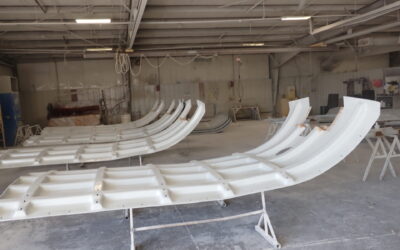
Midwest Cooling Towers fabricates and stocks fiberglass reinforced plastic (FRP) materials and components, including custom parts fabricated at its Chickasha, Oklahoma, facility.
From fan stacks and structural components to cold water basins, piping and fiberglass fittings, having materials readily available helps keep repairs moving without unnecessary delays.
What Opportunities Do Emergency Repairs Create?
Quick answer: An outage can be a chance to address long-term reliability concerns, from aging mechanical equipment to structural deterioration, while the tower is already offline.
Although an outage is never ideal, it often provides an opportunity to address long-term reliability concerns that may have gone unnoticed.
Facilities frequently use emergency repair projects to:
- Replace aging mechanical equipment
- Upgrade fill or drift eliminators
- Repair structural deterioration
- Improve water distribution
- Modernize aging components
- Extend overall tower service life
Addressing these items while repairs are already underway can reduce the likelihood of future unplanned outages.
How Can Facilities Prepare for a Cooling Tower Emergency Before It Happens?
Quick answer: Routine inspections, preventive maintenance and condition assessments help catch developing issues early, and having a response partner in place ahead of time reduces downtime if a failure does occur.
The best emergency response starts long before an emergency occurs.
Routine inspections, preventive maintenance and periodic condition assessments help identify developing issues before they become major failures. Facilities that understand the condition of their cooling towers are often able to plan repairs during scheduled outages instead of responding under emergency conditions.
Even with the best maintenance program, unexpected failures can still happen. Having an experienced cooling tower partner ready to respond can make the difference between days of downtime and a faster return to normal operations.
Frequently Asked Questions
How long does an emergency cooling tower repair typically take?
Repair timelines vary based on the extent of the damage, the components affected and material availability. Contact Midwest Cooling Towers to discuss the specifics of your situation and get a clearer timeline for your facility.
Can a cooling tower be partially repaired while remaining in operation?
In some cases, yes, depending on which components are affected and how the tower is configured. A qualified assessment can determine whether partial operation is possible during repairs or whether a full shutdown is required.
What is the difference between an emergency repair and a planned outage repair?
An emergency repair addresses an unexpected failure under time pressure, while a planned outage repair is scheduled in advance, allowing more flexibility in sourcing materials and coordinating the project timeline.
What information should I have ready before contacting a cooling tower repair specialist?
Photos of the damage, recent operating data, maintenance records and a general description of what happened can help a specialist assess the situation more quickly once contacted.
Partner With Midwest Cooling Towers When Every Hour Counts
When a cooling tower goes down, fast decisions matter. Choosing the right partner matters just as much.
Backed by leadership with 55+ years of cooling tower experience, Midwest Cooling Towers provides industrial facilities with complete cooling tower services, from emergency assessments and repairs to rebuilds, upgrades and long-term maintenance. As an ISO 9001:2015-certified, CTI-member and Women Business Enterprise (WBE)-certified company, MCT offers a single-source approach backed by experienced crews, engineering expertise and extensive FRP inventory and fabrication capabilities.
If your facility is facing an unexpected cooling tower outage, or if you want to prepare before the next one occurs, contact Midwest Cooling Towers. Our team is ready to assess the situation, develop the right repair strategy and restore your cooling tower safely and efficiently.