For decades, wood was the standard for field-erected cooling tower construction. Over time, fiberglass-reinforced plastic (FRP) has become the material of choice for many facilities evaluating new construction, refurbishment or replacement projects. Understanding how and why that shift happened can help facility operators make more informed decisions about their own cooling tower assets.
Why Was Wood the Traditional Material for Field-Erected Cooling Towers?
Quick answer: Wood was widely available, cost-effective to install on-site and had a long track record in cooling tower construction, making it the standard choice for decades.
Wood was well suited to that construction method. It was readily available, relatively easy to work with in the field and could be fabricated into the structural components a tower requires, including framing, decking and fill support.
For many years, wood construction met the needs of industrial facilities. Established construction practices, familiar maintenance routines and a long operating history made it a dependable option for the conditions towers typically faced at the time.
How Do Heat and Moisture Affect Wood Cooling Tower Components Over Time?
Quick answer: Constant exposure to heat and moisture causes wood to rot over time, gradually weakening structural components and increasing maintenance and repair needs.
A cooling tower is one of the more demanding environments for any building material. Wood components are continuously exposed to warm, moist air, recirculating water and changing weather conditions.
Over time, that combination of heat and moisture leads to wood rot. Rot weakens structural members, decking and framing, which can compromise the tower’s integrity if left unaddressed. Facilities operating wood towers need ongoing inspection and repair programs to catch and address rot before it becomes a larger structural issue.
Wood treatments help slow this process, but they do not eliminate it. Wood remains an organic material, and organic materials are naturally susceptible to decay in a hot, humid environment.
How Does FRP Solve the Problems of Wood Construction?
Quick answer: FRP does not rot, rust or decay the way wood does, making it far more resistant to the moisture and chemical exposure inherent to cooling tower operation.
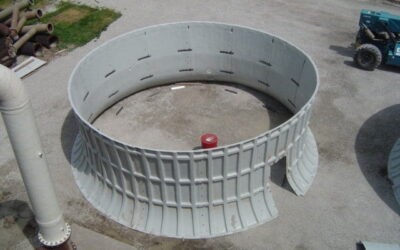
Fiberglass-reinforced plastic addresses the core limitation of wood construction. Because FRP is not an organic material, it does not rot. It also resists the corrosive effects of water treatment chemicals and does not absorb moisture the way wood does.
This corrosion resistance is well documented across the composites industry. The American Composites Manufacturers Association has noted that, unlike wood, steel or concrete, FRP resists corrosion, moisture and pests, which is why it has become a preferred material for infrastructure exposed to harsh conditions.
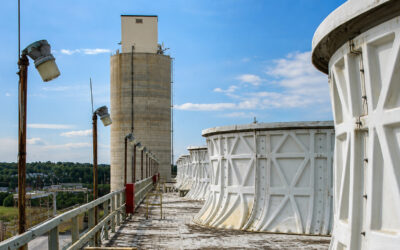
This durability makes FRP particularly well suited to facilities with aggressive water chemistry, high humidity or continuous operating schedules where a tower has little downtime for inspection and repair.
FRP components are also significantly lighter than comparable wood or steel structural elements, which can simplify handling, transport and installation, particularly for retrofit or replacement projects where reducing structural load matters.
Which Material Offers Better Lifecycle Cost, Wood or FRP?
Quick answer: Wood may have a lower initial material cost, but the ongoing inspection, repair and replacement needs driven by rot often make FRP the more cost-effective choice over the life of the tower.
Purchase price is only one part of the total cost of a cooling tower. Lifecycle cost includes inspection, maintenance, component replacement, downtime and the tower’s overall expected service life.
Wood construction often requires more frequent component replacement as rot progresses through structural members. That ongoing repair cycle adds cost and can contribute to unplanned downtime if deterioration is not caught early.
Because FRP resists decay, facilities that choose FRP construction often see reduced replacement frequency for structural components over the life of the tower. Evaluating a tower’s construction material based on total lifecycle cost, rather than upfront price alone, generally provides a clearer picture of long-term value.
What Ongoing Maintenance Does Each Material Require?
Quick answer: Wood towers require regular inspection for rot and structural wear, while FRP maintenance generally focuses on routine cleaning and hardware checks rather than material decay.
Every cooling tower, regardless of construction material, requires routine inspection and preventive maintenance to operate reliably.
Wood towers typically need regular inspection for signs of rot, particularly in areas with consistent moisture exposure such as the lower structure in the basin, fill support structures and any decking or partition walls. Addressing rot early helps extend the useful life of affected components.
FRP components should also be inspected on a routine basis, but that inspection generally centers on hardware, connections and general wear rather than material decay. A comprehensive water treatment program remains important for both materials, since scale, biological growth and water chemistry affect overall system performance regardless of what the structure itself is built from.
Midwest Cooling Towers’ Advantage
Material selection is only one part of a reliable cooling tower. Fabrication quality and repair capability matter just as much.
Midwest Cooling Towers fabricates and stocks FRP components, allowing the company to maintain strict quality standards while supporting replacement parts and custom solutions for facilities transitioning from wood to FRP construction, or maintaining existing FRP towers.
Backed by leadership with 55+ years of cooling tower experience, Midwest Cooling Towers helps customers evaluate the right construction material for their application, whether that means repairing an existing wood tower, planning an FRP retrofit or designing a new installation.
As an active member of the Cooling Technology Institute, Midwest Cooling Towers stays aligned with the engineering standards and testing practices that guide cooling tower design, construction and performance across the industry.
Whether you are managing an aging wood tower, evaluating a refurbishment or planning new construction, choosing the right material can have a lasting impact on maintenance needs and equipment life.
Ready to evaluate your cooling tower? Contact Midwest Cooling Towers to discuss your application and learn whether FRP, a wood and FRP combination, or another approach is the best fit for your facility.
Frequently Asked Questions
Does switching from wood to FRP affect a cooling tower’s thermal performance?
Not inherently. FRP structural components are designed to support the same fill media, drift eliminators and mechanical equipment as wood construction. Thermal performance depends primarily on the fill, airflow and water treatment program rather than the structural material itself, so a well-designed FRP conversion should maintain the tower’s cooling performance.
Can an existing wood cooling tower be converted to FRP?
In many cases, yes. Facilities often replace wood structural components with FRP during a refurbishment project. Contact Midwest Cooling Towers to discuss whether a conversion makes sense for your specific tower.
How long does FRP last compared to wood in a cooling tower?
Service life varies by application and operating environment, but because FRP does not rot the way wood does, it generally has a much longer service life and requires less structural replacement over time. Contact Midwest Cooling Towers to discuss expected performance for your specific conditions.
Is a full FRP tower always necessary, or can wood and FRP be combined?
Many towers use a combination of materials, replacing the most moisture-exposed wood components with FRP while retaining other serviceable structural elements. The right approach depends on the tower’s condition and the facility’s goals.
Start With the Right Material for Your Application
Whether you are maintaining a wood cooling tower, planning an FRP conversion or evaluating new construction, understanding how construction materials perform over time can help guide a more informed decision. Contact Midwest Cooling Towers to discuss your facility’s cooling tower and find the right material for your application.